A Philosophical Stoic (Stoicism) Approach to My Photography
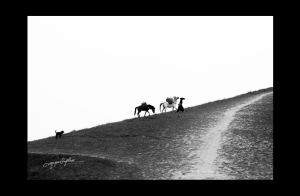
This photograph embodies Stoicism through its use of space, light, and minimalist composition. Below are some philosophical perspectives that can be analyzed, allowing you to reflect on life through photography.
1. The Smallness of Humanity in the Face of Nature
In the image, a person, a horse, and a dog appear on a vast hillside, with an expansive white sky above them. Space creates a sense of the universe’s immensity, where humans are a tiny part of a greater whole. This reflects an existentialist perspective on the finiteness of human life in the vast world, reminding us to remain humble before nature.
2. Minimalism and Emptiness
By removing unnecessary details and retaining only essential elements, the photograph captures the spirit of minimalism in photography and philosophy. The blank white sky can symbolize nihilism—where everything returns to its undefined essence. It can also evoke a sense of stillness and meditation, in which one seeks to understand oneself more deeply.
3. Life’s Journey and Fate
Human life is constantly moving forward, striving upward as an inevitable law of growth. The hill in the photograph can be seen as a metaphor for each person’s challenges. The peak represents success, maturity, and great aspirations. Conversely, if one stumbles, they may fall into the abyss of failure, where efforts seem meaningless.
However, the dog’s position in the photograph is a crucial detail. It does not turn back or give up but continues moving forward, reflecting perseverance and an unyielding spirit in the face of adversity. In Stoic philosophy, one of the most important lessons is to accept challenges and keep moving forward, as the journey truly matters, not just the destination.
4. Different Attitudes Toward Hardship
The image of the two horses and their owner also conveys intriguing philosophical insights into how humans react to challenges:
The horse’s lowered head symbolizes submission to hardship. It may represent moments when people feel exhausted and lose faith in themselves when faced with long, steep paths.
The horse with its head held high symbolizes confidence and bravery. It demonstrates a strong spirit, ready to face challenges without being overwhelmed by difficulties.
The owner is looking downward, in a state of hesitation and uncertainty. She is still moving forward, but her resolve may be wavering, torn between perseverance and the fear of failure. This reflects a truth in life: sometimes, we know we must continue, yet our minds are filled with doubts and worries.
The three heads (of the two horses and their owner) form a visually meaningful rhythm, representing the struggle between determination, fear, and acceptance. Willpower is not always steadfast; it fluctuates through different phases of one’s journey.
5. Destination and Purpose
Ultimately, the most important thing is for each individual to determine their destination. No one can avoid life’s uphill struggles, but perseverance in reaching the end of the road defines true victory. In Buddhist thought, life is a cycle of cause and effect: those who continuously strive will have the opportunity to achieve what they desire.
Look at the photograph and ask yourself: Who are you on this path? Are you the one persistently moving forward, the one collapsing mid-journey, or the small dog who, despite its size, is determined to push ahead?
Nguyen Vu Phuoc
Feb 2025